
Asset Groups - Carbon Black
PROJECT BACKGROUND
In the realm of cybersecurity, different types of computers and servers (endpoints) require different kinds of security protection and configuration. For instance, application activity on a critical server can be heavily restricted, while essential applications for productivity on a development machine can run freely. To manage this at scale, endpoints can be grouped into categories, allowing customers to assign different configurations to each group.
PROBLEM SUMMARY
The existing 7 year old legacy grouping framework was outdated, with limited configuration capabilities, lack of extensibility for future innovation, and low adoption rates. Only 10% of customers used this functionality, and opted for a manual and inefficient method of organization instead.
As the UX designer on the project, I led the team to completely reimagine and redesign a new framework from the ground up. We delivered an intuitive, flexible, and powerful solution that significantly improved adoption and prepared the product for future innovations. Upon launch, adoption surpassed the legacy rate in only three months.
IMAGINING A NEW FRAMEWORK
-
Collaborated with stakeholders and customers to brainstorm and generate multiple solutions for enhancing the framework.
-
Incorporated innovative ideas to leverage the new platform in support of upcoming product features.
-
Participated in multiple user research sessions and continuously iterated on the design to ensure optimal user experience and satisfaction

Users required a comprehensive and robust yet simple method to organize their endpoints effectively, ensuring ease of management and visibility into configurations. Future configuration types, such as setting software version and role-based access control, would also need to leverage this platform for consistency and efficiency.
ADDING FLEXIBILITY AND CONTROL
-
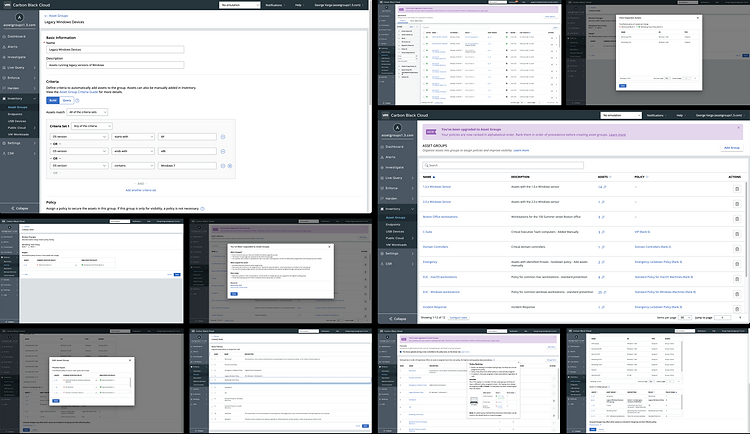
Designed a simple yet powerful interface to build complex queries using AND and OR statements that added endpoints to groups upon a match
-
The final design became a standard pattern used in other areas of the product.
-
Incorporated an advanced mode that allows users to manually type in queries, supporting two different user input methods.
Users needed a simple way to automatically add hundreds of endpoints into groups based on each endpoint's metadata.
PREVIEWING IMPACT
-
Implemented a “Preview Impact” design allowing users to see the effect of their configuration edits before saving changes.
-
Designed the pattern to enable users to make multiple adjustments until they are confident in the results.
-
Engaged in user testing to ensure the impact summary was clear and easy to understand.
Making unintended changes to the configuration of endpoints could disrupt business-critical functions. Users needed a safe way to make changes.
SIMPLIFYING COMPLEXITY
-
Designed a new in-product workflow to guide existing users through the upgrade process from the legacy system to the new platform.
-
Created page banners to inform users about the launch date, availability, and next steps for the upgrade.
-
Developed clear and simple messaging to explain the feature, its benefits, and best practice examples.
-
Used Rapid Iterative Testing and Evaluation to determine the most effective ways to display the information.
The foundational principles of the new framework were significantly different from the legacy system. Both existing and new customers needed to quickly understand how to leverage the new platform to efficiently manage their endpoint security configurations.
